
Home / Notes / Five vector databases on RBI documents
Research note · 22 October 2026
What testing five vector databases on RBI documents taught us
We compared approximate vector search with exact search across five backends, two fixed RBI document views and three repeats. These results describe retrieval measurements, not legal-answer accuracy.
27 October 2026 · Curator Research
—
The question and the boundary
Fast search is useful only when we know how closely it matches an exact search. We separately measured whether a labelled source document appeared among the first ten distinct documents. Neither measure tests whether a generated answer is correct. Experiments ran on 18 October 2026; the report was prepared 22 October 2026.
Results across both data views
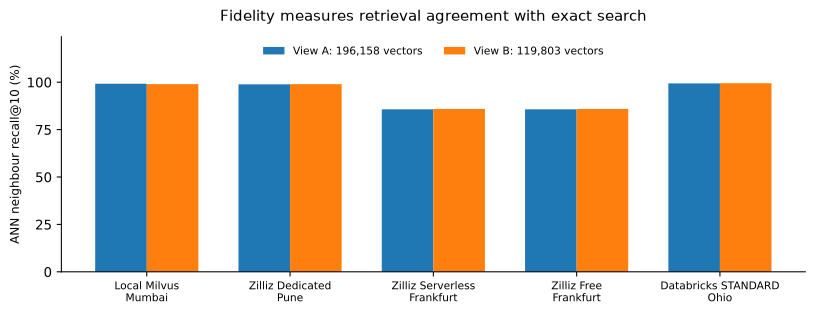
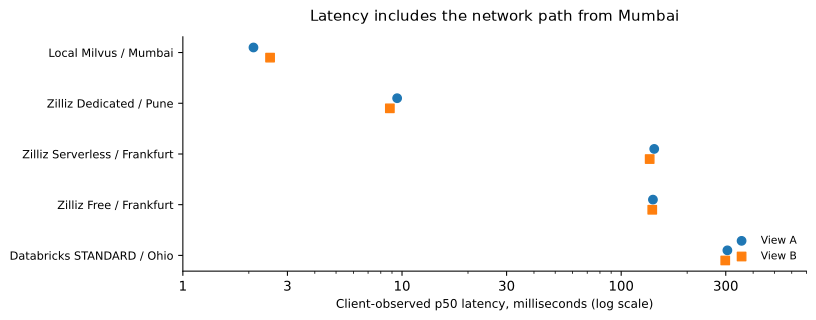
All values are medians of three repeats. ANN neighbour recall@10 compares approximate and exact top-ten vector results. Document hit@10 checks the labelled document within the first ten distinct documents, grouped from the first 100 vector results. Client p50 is single-query latency from the Mumbai client.
| Backend and tested location | ANN recall@10 A / B | Document hit@10 A / B | Client p50 A / B |
|---|---|---|---|
| Local Milvus · Mumbai loopback | 99.2% / 99.0% | 90.3% / 90.3% | 2.1 / 2.5 ms |
| Zilliz Dedicated · Pune | 98.9% / 99.0% | 91.0% / 90.7% | 9.5 / 8.8 ms |
| Zilliz Serverless · Frankfurt | 85.7% / 85.9% | 87.4% / 88.1% | 141.5 / 134.9 ms |
| Zilliz Free · Frankfurt | 85.7% / 85.9% | 87.4% / 88.1% | 139.6 / 138.6 ms |
| Databricks STANDARD · Ohio | 99.4% / 99.5% | 90.7% / 90.7% | 305.2 / 298.4 ms |
A: 196,158 vectors and 1,305 questions. B: 119,803 vectors and 756 questions. Different regions and resources, busy timing phases, default Zilliz AUTOINDEX settings, and three repeats limit comparisons. No statistical superiority or equivalence is claimed.
—
What the measurements do and do not say
The local, Dedicated and Databricks setups closely matched exact search in these runs. Serverless and Free matched less often at their default settings; their tuning options were not tested in this evaluation. Network distance contributes to the latency spread, so these results do not rank database engines. The experiment did not measure answer correctness, production scale, total cost of ownership, or legal interpretation. The corpus is an RBI-only slice and is not representative of every RBI publication.
—
Data, method and limitations
Each backend used the same cached Qwen3-Embedding-8B vectors reduced to 1,024 dimensions within each view. The clean view removes documents lacking scraper metadata and questions dependent on them. The data retains duplicate passages across documents and incomplete section/version lineage. A new independently human-reviewed hard question set was not completed. No paired significance or equivalence analysis was run.
—
Files and further reading
The technical report and machine-readable result set preserve the detailed tables and fingerprints. The charts show exact-search agreement and client latency; neither chart measures answer correctness.
Disagree with us? Tell us why.
We publish the measurement, its date and its scope so you can check our reasoning. If you think we got something wrong, write to us.